Earl Grey
Happy new year, everybody! As a student I have exams session the whole January. Now that's what I call holiday.
With that amount of sparetime I had to do a project. Having started numerous, I'll now tell you about a tea-related one.
Problem statement
Wikipedia contains interesting informaion about the Earl Grey blend. It states that the original Earl Grey was not flavoured assam tea but rather was a mix of
- assam
- DianHong
- Darjeeling
- and even Lapsang tea.
Of course I was not able to find an original recipe so I thought I should conduct an experiment to find out what the proportions should be for the blend to taste the best.
Experimental
All I had to do was randomize some percentages. I carefully weighed the ingredients and mixed the with bergamot oil (anout 6 drops per 25 g of tea). You can see the resulting mixes in a table below. The columns' and rows' names are clickable. Definetely try them out!
I tracked reviews with a google form.
Results
The main observation: there is a strong positive correlation between the amount of assam tea in blend and the total score, strong negative between the percentage of darjeeing and mark and not-so-clear with lapsang and dian hong.
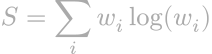
For each mix I calculated the entropy. I defined it as a negative sum of mass percentage times logarithm of mass persentage analogous to Claude Shannon's definition (see below). Unfortunately, turns out there is only weak negative correlation.
The final rating is as follows: 5>2>1>3>4. Haven't tested the 6th yet and not really planning to. Maybe later though.
Conclusion
This is quite amusing as there is room for interpretation.
I think the assam-mark correlation is the strongest positive because of the sample of people.That is my family) This is quite limiting as a) they have similar taste b) they drink a lot of store-bought Earl Grey. This made me think that while degustating they did not give a mark per se but rather a score of similarity to the industrial Earl Grey.
If you ask me, mix #5 turned out to be my favourite. It is the only one I found to incorporate darjeeling organically.
a-for-short